
The Paradox of the Modern Marketing Stack
In the current digital landscape, we are witnessing a strange paradox. Organisations have access to more sophisticated marketing technology than ever before. Cloud computing, real-time data processing, and AI-driven insights are theoretically at the fingertips of every CMO. Yet, despite the billions of dollars poured into these platforms, Adobe, Salesforce, Google, and beyond, many enterprises report a diminishing return on their MarTech investments.
They find themselves “data rich but insight poor.” They possess a fragmented “Franken-stack” where tools don’t talk to each other, data is trapped in regional silos, and the promise of a unified customer view remains a distant dream. High-end software is often treated as a “silver bullet,” but without a clear strategic roadmap, it merely creates a more expensive version of the same old problems.
The reason for this failure is rarely a lack of features in the software. Instead, it is a lack of MarTech Maturity. Organisations often jump into high-end implementations without the strategic foundation required to sustain them. They focus on the “what” (the tools) instead of the “how” (the strategy and maturity) and the “why” (the customer lifecycle). To truly unlock the value of MarTech, we must shift our perspective from being tool-collectors to becoming strategic architects of a mature ecosystem.
The Four Pillars Built on One Foundation
MarTech Maturity is not a destination. It is the measure of an organisation’s ability to effectively integrate technology, data, and strategy to drive measurable business growth. Based on over two decades of experience in the field, I have identified a framework of one foundation and four essential pillars that define a mature marketing organisation.
The structure is hierarchical, not flat. Data collection serves as the singular foundation. Without it, nothing else stands. The other four pillars, Analytics & Reporting, Data Platform, Marketing Automation, and Testing & Personalisation, are built on top of this foundation. A crack in the foundation compromises everything above it.

The Foundation: Data Collection (The Bedrock of Integrity)
A mature stack begins with high-integrity data. This is the bedrock upon which all other capabilities are built. Data Collection in a mature environment goes beyond simply placing a tracking tag on a website. It represents a governed, scalable, and multi-market architecture.
In low-maturity organisations, tracking is often an afterthought, implemented inconsistently across different digital properties. In high-maturity environments, data collection is a centralised process. It involves rigorous Solution Design Reference (SDR) documentation, standardised data layers, and automated Quality Assurance (QA) to ensure data accuracy 24/7. Furthermore, it must be compliant with global privacy regulations (GDPR, CCPA), ensuring that the foundation of your data is not only technically sound but also legally secure.
Why is this THE foundation? Because every other capability depends on it. You cannot have accurate analytics without accurate data. You cannot build a unified customer profile from fragmented inputs. You cannot automate personalised journeys if you don’t know who the customer is or what they did. Data Collection is not “Pillar 1 of 5”. It is the ground everything else stands on.
Pillar 1: Analytics and Reporting (The Insight & Visibility)
Data without interpretation is merely noise. The first pillar, built on the foundation, focuses on transforming raw data into actionable insights. Maturity in this dimension means moving from “Hindsight” to “Foresight.”
At the early stages, reporting is often manual, static, and disconnected. Relying on monthly PDF exports that are already outdated by the time they reach a stakeholder’s desk. As maturity grows, the organisation transitions to real-time, self-service dashboards. High-maturity analytics involves advanced multi-touch attribution models and the ability to connect digital behaviours directly to downstream business value, such as Annual Premium Equivalent (APE) or incremental revenue. The goal is to create a “Single Source of Truth” that empowers every team to make data-driven decisions.
Pillar 2: Data Platform (The Infrastructure & Unification)
The second pillar is the infrastructure that allows data to flow seamlessly across the organisation. It is the connective tissue of the MarTech stack. In low-maturity environments, organisations operate with “Data Islands”, where the web team, the CRM team, and the media team all look at different, conflicting datasets.
Maturity here involves the implementation of unified Data Platforms, such as Customer Data Platforms (CDP) or centralised Data Lakes. The objective is to achieve a “Golden Record”. A single, holistic view of each customer that persists across all touchpoints. This unified infrastructure allows for the stitching together of anonymous web behaviour with known customer CRM data, enabling a level of sophisticated analysis and targeting that is impossible with siloed systems.
Pillar 3: Marketing Automation (The Efficiency & Orchestration)
The third pillar represents the orchestration of customer engagement. This is where strategic plans are turned into automated actions. In a low-maturity setting, marketing communications are often “Batch and Blast”, sending the same message to every customer regardless of their needs or behaviours.
As maturity increases, the organisation shifts toward triggered, event-based orchestration. Marketing Automation allows for complex, multi-step customer journeys that run 24/7 without manual intervention. Mature automation is not just about sending emails. It’s about cross-channel orchestration, where the website, mobile app, email, and even offline call centres work in harmony to guide a customer through their journey. This pillar is the primary driver of operational efficiency and scalability.
Pillar 4: Testing and Personalisation (The Optimisation & Experience)
The fourth and final pillar is where the customer experience is refined and optimised. This is the “Execution Force” of the MarTech stack. If your personalisation is limited to using a customer’s first name in an email subject line, you are only scratching the surface.
High-maturity organizations utilize rigorous A/B and multivariate testing to make evidence-based improvements to the user experience. This evolves into sophisticated Personalization, where content, offers, and layouts adapt in real-time based on the user’s current intent, past behaviour, and propensity scores. This level of maturity requires a tight feedback loop between your analytics (Pillar 1) and your execution tools, ensuring that the experience is always improving and always relevant.
The Digital Customer Lifecycle Lens
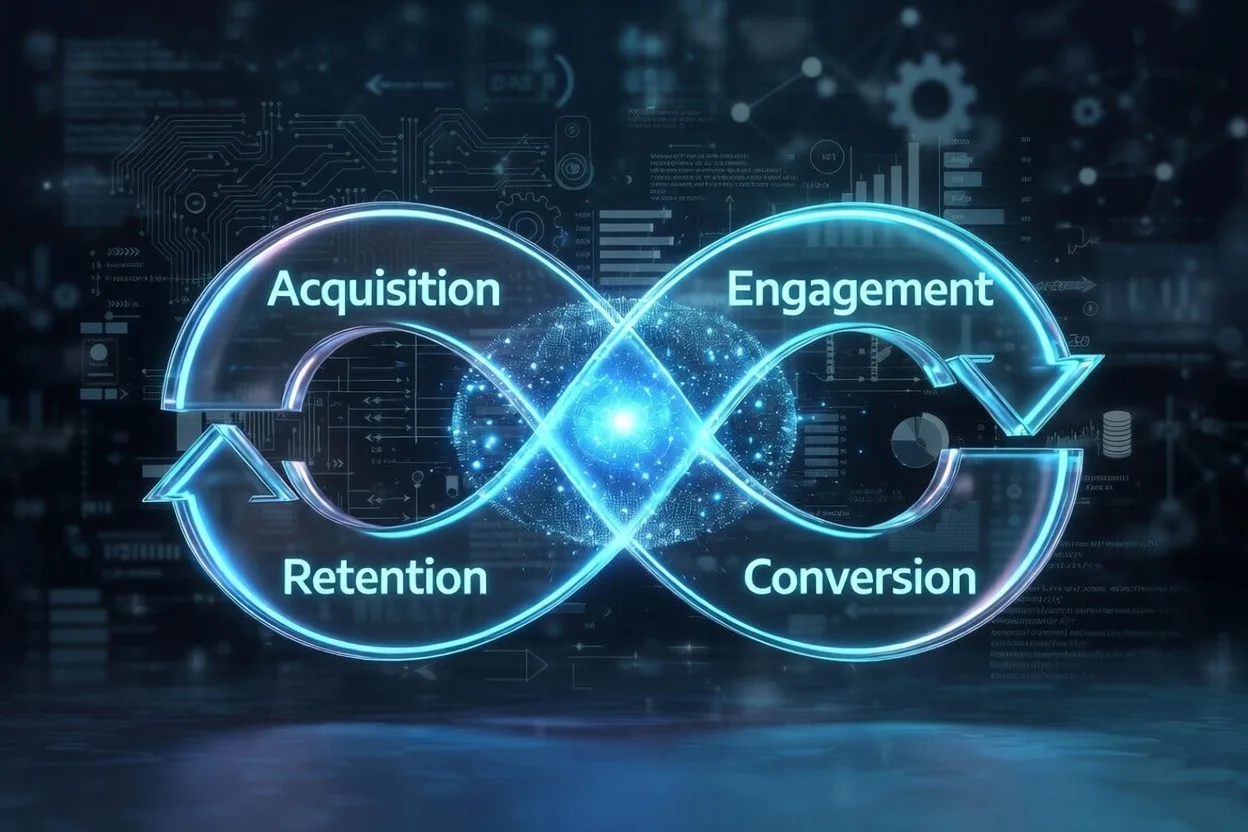
To navigate the path to maturity, we must anchor the foundation and four pillars in the Digital Customer Lifecycle. Technology should not exist for its own sake. It should exist to facilitate the customer’s journey from awareness to loyalty.
Phase 1: Acquisition & Discovery
At this stage, maturity manifests as Channel Efficiency. Are you wasting budget on audiences that have already converted? Mature organisations use their Data Collection (Foundation) and Data Platform (Pillar 2) to build feedback loops with media platforms like Google and Meta. By sharing high-quality signal data, they can optimise their spend toward high-value prospects, significantly reducing their Customer Acquisition Cost (CAC).
Phase 2: Engagement & Consideration
Once an anonymous visitor lands on your property, maturity shifts to Intent Understanding. Instead of just tracking page views, a mature stack (via the Foundation and Pillar 1) measures micro-conversions and engagement scores. This data is then used via Pillar 4 (Testing & Personalisation) to ensure the user is presented with the most relevant content to move them to the next stage of the funnel.
Phase 3: Conversion & Purchase
This is the moment of truth. Maturity here is about Friction Reduction. Are you using your Data Platform (Pillar 2) to pre-populate forms or predict a user’s preference? A mature stack identifies the “leaky” parts of the funnel and deploys automated nudges (Pillar 3) to guide the user across the finish line.
Phase 4: Retention & Advocacy
The most mature organisations know that the sale is only the beginning. By feeding purchase data back into propensity models, they can identify who is likely to churn and who is ready for an upsell. This creates a “Perpetual Growth Machine” where the data from existing customers is used to find and convert the next generation of high-value prospects.
Why Maturity is a Strategic Necessity (The Business Case)
In an era of rising acquisition costs and tightening budgets, MarTech Maturity is no longer a luxury. It is a survival requirement for any digital-first business. At the heart of this maturity framework is a move away from one-off, “hard-coded” solutions toward a system defined by three core attributes: Flexibility, Scalability, and Reusability.

- Lowering CAC and Boosting LTV: By eliminating wasted media spend and optimising for actual lifetime value rather than single-session clicks, a mature stack turns marketing from a cost centre into a growth engine.
- Flexibility: Agility in a Changing Landscape: A mature stack is built with an “Agile Business” mindset. It provides the Flexibility to adapt to changing market conditions or regional requirements without needing to re-engineer the entire foundation. Whether it’s pivoting to a new privacy regulation or integrating a new local payment provider, a flexible architecture allows the organisation to remain nimble.
- Scalability: Growth Without Friction: For multinational organisations, the primary challenge is scaling. Maturity provides the Scalability to manage one digital property as effectively as one hundred. It allows a centralised core of governance and data integrity to support rapid expansion across different brands and regions without a linear increase in headcount or technical overhead.
- Reusability: The Efficiency Multiplier: This is often the most overlooked benefit of MarTech maturity. By creating a standardised, Reusable framework-ranging from reusable data layers and tagging structures to modular marketing automation workflows, organisations can drastically reduce speed-to-market. Instead of reinventing the wheel for every campaign or market launch, teams can leverage a shared library of technical and strategic assets, ensuring consistency and massive cost savings.
- Governance at Scale: For enterprises operating at a global scale, maturity enables a central team to maintain global standards while empowering local markets with the tools they need to succeed. A balance that is purely impossible to achieve in a low-maturity, siloed environment.
Mapping Your Journey
The path to MarTech Maturity is a marathon, not a sprint. It requires a culture shift as much as a shift in technology. It requires a move from being a “Tool Collector” to becoming a “Strategic Architect.”
Throughout this Knowledge Hub, we will provide the roadmap for this transformation. We will move beyond the theory and look at the practical, technical, and organisational frameworks required to reach Stage 4 maturity across the foundation and all four pillars.